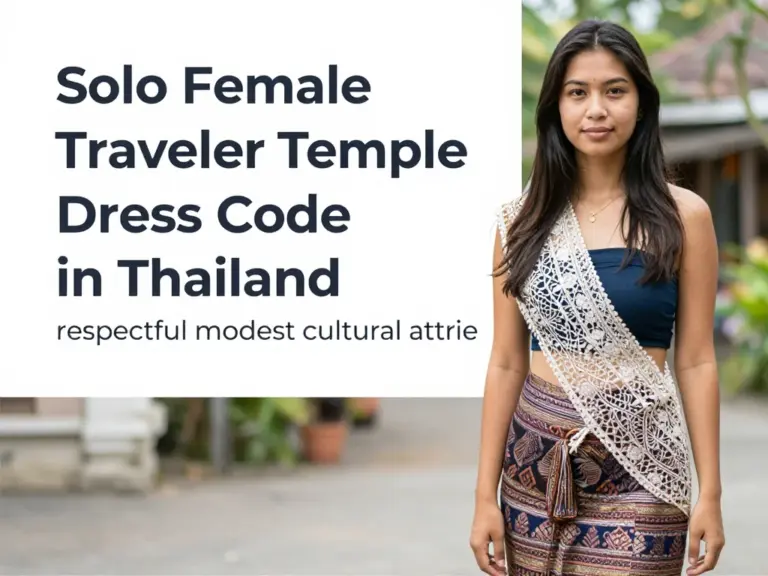
Temple Dress Codes in Thailand for Solo Female Travelers: Save Time and Respect Local Culture
- Temple Dress Codes in Thailand for Solo Female Travelers: Save Time and Respect Local Culture
Exploring the serene and ornate wats (temples) of Thailand is a highlight for any solo traveler. However, navigating temple dress codes in Thailand for solo female travelers can sometimes feel daunting when you are trying to balance comfort, the tropical heat, and cultural respect. Understanding these requirements not only saves you time at the entrance gate but also ensures you engage with local culture in the most respectful way possible.
temple dress codes in Thailand for solo female travelers: Understanding the Importance of Respectful Attire
In Thai culture, temples are considered sacred spaces. The dress code is not merely a bureaucratic rule; it is a reflection of reverence for Buddhist teachings and the monastic community. For solo female travelers, adhering to these standards is a simple yet powerful way to show that you are a mindful visitor. When you dress appropriately, you avoid being denied entry—a common frustration for tourists—and you foster positive interactions with monks and locals.
The Golden Rules of Temple Attire
The core principle is modesty. While Thailand is hot, temples require you to cover up. Think of it as transitioning from your “tourist mode” to “pilgrim mode” for the duration of your visit. Here are the non-negotiable standards:
- Cover your shoulders: Tank tops, spaghetti straps, and off-the-shoulder tops are generally not permitted.
- Cover your knees: Shorts, short skirts, and ripped jeans that expose the knees are strictly prohibited.
- Avoid sheer fabrics: Even if your clothes cover your skin, if the fabric is see-through, it may be deemed inappropriate.
- Footwear: You must remove your shoes before entering the main temple buildings (wihan or ubosot).
Practical Packing Strategy for Solo Travelers
As a solo traveler, your luggage space is precious. You do not need to pack a separate wardrobe for temples. Instead, use a “layering” strategy. Carry a lightweight sarong or a large scarf in your day bag. It takes up almost no space and can be quickly wrapped around your waist as a skirt or draped over your shoulders like a shawl when you arrive at a temple entrance. This is the ultimate time-saver.
| Item | Temple Friendly? | Tip |
|---|---|---|
| Maxi Dress | Yes | Ensure the back is not too open. |
| Leggings | Usually No | Often considered too tight; better to wear loose trousers. |
| Sarong | Yes | The ultimate versatile tool for temple visits. |
| Shorts | No | Keep these for the beach or city streets only. |
Checklist: Before You Leave Your Hotel
Follow this quick checklist to ensure you are ready for a day of temple hopping:
- Check your top: Does it cover your shoulders completely?
- Check your bottoms: Are they loose-fitting and reach below the knee?
- Pack your cover-up: Did you bring that sarong or scarf?
- Consider your socks: Some temple floors can get scorching hot under the sun; slipping on a pair of socks before entering can be a lifesaver.
- Check the weather: If it’s raining, ensure your clothes aren’t too thin.
What Happens If You Forget?
Don’t panic if you realize you are underdressed at the entrance. Most major tourist temples, such as the Grand Palace in Bangkok or Wat Arun, offer sarong rentals or sales. However, renting can be time-consuming, involve queues, and require a deposit. Buying one is an easy souvenir, but it is always better to be prepared with your own gear to save money and time.
Conclusion
Navigating temple dress codes in Thailand for solo female travelers is straightforward once you know the basics. By keeping your shoulders and knees covered and carrying a versatile sarong, you can move seamlessly between the vibrant streets of Bangkok and the peaceful grounds of ancient temples. Respectful dressing is a small gesture that goes a long way in making your solo journey through Thailand more meaningful and hassle-free.
Frequently Asked Questions (FAQ)
A: Generally, no. Leggings are often considered too form-fitting to be respectful in a religious setting. It is safer to wear loose-fitting linen pants or a long skirt.
A: You only need to remove your shoes before entering the specific building where the Buddha image is housed (the main temple hall). You can keep your shoes on while walking around the exterior temple grounds.
A: While the core rules (shoulders and knees covered) apply everywhere, some very strict or royal temples may have even more stringent requirements. It is always best to err on the side of modesty.