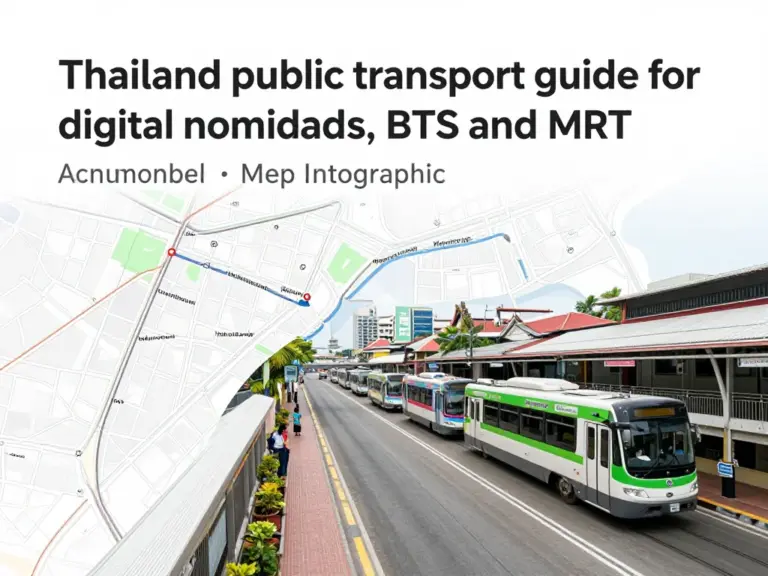
Thailand Public Transport Guide for Digital Nomads: BTS and MRT Made Easy
For digital nomads settling into the vibrant rhythm of Bangkok, mastering the city’s transit network is the ultimate productivity hack. This Thailand public transport guide for digital nomads is designed to cut through the confusion, helping you navigate the BTS Skytrain and MRT Subway systems with confidence, saving you both time and stress during your stay.
Thailand public transport guide for digital nomads: Understanding the Backbone of Bangkok Transit
Bangkok’s rapid transit system is divided into two primary networks that serve as the lifeline for commuters and expats alike. While they are operated by different entities, they are increasingly integrated, making your daily commute to coworking spaces or cafes much smoother.
The BTS Skytrain
The BTS (Bangkok Mass Transit System) runs on elevated tracks, offering a bird’s-eye view of the city. It is the most popular way to bypass Bangkok’s notorious traffic jams. The two main lines—the Sukhumvit Line and the Silom Line—connect the primary business districts, shopping hubs, and popular expat residential areas.
The MRT Subway
The MRT (Metropolitan Rapid Transit) operates mostly underground. It is incredibly efficient for reaching areas not covered by the Skytrain, such as the Rama 9 business district, Chinatown, and the vibrant nightlife areas near Sukhumvit. The Blue Line and Purple Line are the primary arteries here.
Comparison: BTS vs. MRT
| Feature | BTS Skytrain | MRT Subway |
|---|---|---|
| Infrastructure | Elevated | Underground |
| Payment | Rabbit Card / QR | EMV Contactless / MRT Card |
| Best For | Sukhumvit, Siam, Sathorn | Rama 9, Chinatown, Old City |
| Integration | High | High |
Essential Tips for Digital Nomads
To truly excel at commuting in Thailand, you need to go beyond just buying a ticket. Digital nomads should optimize their travel strategy to avoid peak hour crushes and ensure seamless payment processing.
1. Embrace Contactless Payments
Gone are the days of fumbling for coins. The MRT now widely accepts EMV contactless credit and debit cards, which is a massive convenience. For the BTS, while credit cards aren’t directly supported at turnstiles yet, the Rabbit Card is essential. You can top it up via mobile banking apps, saving you from waiting in ticket machine queues.
2. Avoiding Rush Hour
If you can, structure your work hours to avoid the peak transit times of 7:30 AM – 9:30 AM and 5:00 PM – 7:00 PM. During these windows, stations can become extremely crowded, and finding space on the train can be challenging.
Commuter Checklist
- Get a Rabbit Card: Essential for BTS travel.
- Download Transit Apps: Use Google Maps or Citymapper for real-time routing.
- Keep a Power Bank: Long commutes might drain your phone; ensure you have enough battery for navigation.
- Carry a Light Jacket: The air conditioning on trains is famously powerful and can be freezing.
Interchange stations are where the BTS and MRT networks meet. Key stations like Asok/Sukhumvit and Sala Daeng/Silom allow you to switch between the two systems. Note that you will need to exit one station and enter the other, which means paying separate fares—a small price to pay for the efficiency of reaching your destination.
Conclusion
Thailand’s public transport system is a powerful tool for any digital nomad. By understanding the nuances of the BTS and MRT, you gain the freedom to explore Bangkok without being tethered to taxis or ride-hailing apps. Start with a Rabbit Card, keep a contactless card handy for the MRT, and you will be navigating the city like a local in no time.
Frequently Asked Questions (FAQ)
A: No, the BTS and MRT operate on different payment systems. You will need a Rabbit Card for the BTS and either a separate MRT card or a compatible contactless bank card for the MRT.
A: Yes, Google Maps is highly accurate for route planning. For specific transit schedules and fare calculations, the BTS and MRT official websites provide detailed information.
A: Depending on the distance, a single trip usually costs between 25 and 60 THB. A daily budget of 150-200 THB is more than sufficient for most nomads.