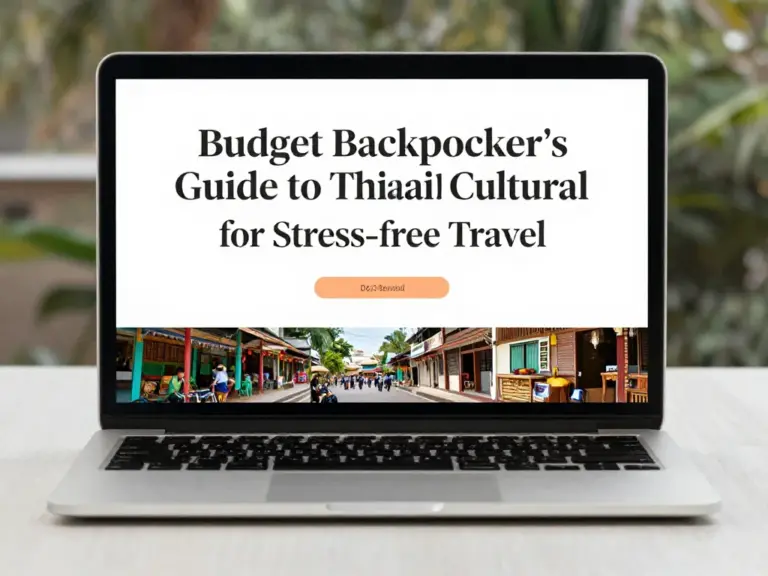
Cultural Etiquette in Thailand: A Budget Backpacker’s Guide to Stress-Free Travel
- Cultural Etiquette in Thailand: A Budget Backpacker’s Guide to Stress-Free Travel
Traveling to the Land of Smiles is a rite of passage for many backpackers, but navigating social norms can be daunting. Understanding cultural etiquette in Thailand is not just about avoiding awkward moments; it is about showing genuine respect to a culture that deeply values harmony and politeness. By learning a few key behaviors, you can transform your trip from a standard tourist experience into a more meaningful and stress-free adventure.
cultural etiquette in Thailand: The Concept of ‘Jai Yen’ and ‘Mai Pen Rai’
To truly travel like a local, you must grasp two fundamental pillars of Thai social interaction. First, Jai Yen, which literally translates to ‘cool heart.’ It refers to keeping your composure, especially in stressful situations like missed buses or language barriers. Getting angry or raising your voice is seen as a loss of face and rarely solves the problem.
Second, Mai Pen Rai, or ‘no worries.’ This reflects the Thai approach to life—letting small inconveniences slide. If you adopt these mindsets, you will find that locals are much more willing to help you, making your backpacking journey significantly smoother.
Respecting Religious Sites and Customs
Temples (Wats) are the heart of Thai culture. When visiting these sacred spaces, strict dress codes apply. Both men and women should ensure their shoulders and knees are covered. It is also standard practice to remove your shoes before entering temple buildings or even some private homes and shops.
Social Hierarchy and The Wai
Thai society is hierarchical, and the Wai—the traditional greeting of pressing palms together at chest level with a slight bow—is the primary way to acknowledge this. As a tourist, you are not expected to initiate the Wai, but you should return it if someone greets you this way. Avoid using the Wai for service staff or children; a simple smile is sufficient.
The Head and The Feet
In Thai culture, the head is considered the most sacred part of the body, and the feet the lowest and dirtiest. Never touch someone on the head, even children. Conversely, avoid pointing your feet at people, religious statues, or images of the King. Using your feet to push a door or point at an object is considered highly disrespectful.
Dining and Budget Etiquette
Budget travel often revolves around street food. When dining, remember that communal eating is the norm. Dishes are shared, and you should use the serving spoon provided rather than your own utensils. Tipping is not mandatory in Thailand, though rounding up your bill or leaving small change is appreciated in restaurants. For street food, exact change is always preferred.
| Action | Do | Don’t |
|---|---|---|
| Entering a Temple | Remove shoes and cover shoulders/knees | Wear hats or sunglasses inside |
| Interaction | Smile and keep your voice calm | Raise your voice or get angry |
| Physical Contact | Keep personal space | Touch anyone’s head |
| Pointing | Use your whole hand | Point with your feet or finger |
Checklist for a Respectful Trip
- Dress modestly: Keep shoulders and knees covered in rural areas and temples.
- Learn basic phrases: ‘Sawadee-krap’ (male) or ‘Sawadee-ka’ (female) goes a long way.
- Remove shoes: Look for piles of shoes outside shops or homes.
- Respect the Monarchy: Never speak ill of the Royal Family; it is a serious legal offense.
- Stay calm: Maintain a ‘Jai Yen’ attitude to resolve disputes.
Conclusion
Mastering cultural etiquette in Thailand is about more than just avoiding social faux pas; it is a gateway to deeper connections with the people and places you visit. By showing respect for local traditions, you will find that your backpacking experience becomes richer, warmer, and infinitely more rewarding. Keep it simple, stay humble, and enjoy your journey through this beautiful country.
Frequently Asked Questions (FAQ)
Is it rude to tip in Thailand?
Tipping is not expected, but it is appreciated. For small street food meals, it is not necessary. In nice restaurants, leaving 20-50 THB or rounding up the bill is a kind gesture.
Can I wear shorts in Thai temples?
Generally, no. Both men and women are expected to cover their knees and shoulders when entering religious sites. Some popular tourist temples may offer sarong rentals, but it is better to be prepared.
How do I handle a conflict in Thailand?
Always maintain your composure. Raising your voice or showing aggression is considered a loss of face and will likely make the situation worse. Smile, stay calm, and try to negotiate politely.