Local Transportation in Thailand: A First-Time Visitor’s Guide to Getting Around Without Embarrassment
- Local Transportation in Thailand: A First-Time Visitor’s Guide to Getting Around Without Embarrassment
Navigating the bustling streets of Thailand for the first time can feel like a daunting task, especially when you are faced with a dizzying array of options ranging from sleek, air-conditioned metro lines to open-air tuk-tuks. Understanding local transportation in Thailand is not just about getting from point A to point B; it is about immersing yourself in the culture while avoiding the common pitfalls that lead to overpaying or unnecessary frustration. This guide is designed to empower first-time visitors with the technical know-how and cultural context needed to move through the country with confidence.
local transportation in Thailand: Understanding the Modern Digital Arsenal for Travel
The era of blindly hailing a taxi on the street and hoping for a fair price is largely behind us, thanks to the rise of ride-hailing technology. For the modern traveler, your smartphone is your most valuable asset when navigating local transportation in Thailand. The most reliable application is Grab, which functions similarly to Uber or Lyft. It offers upfront pricing, driver tracking, and a rating system that significantly reduces the risk of scams.
Beyond Grab, Bolt and Maxim are popular alternatives that often provide cheaper rates in certain urban areas. However, keep in mind that availability can fluctuate. When using these apps, ensure you have a local SIM card or a reliable roaming data plan, as you will need consistent internet access to book rides and communicate with drivers who may have limited English proficiency.
Bangkok’s rail network is the gold standard for avoiding the city’s notorious traffic congestion. There are two primary systems you need to distinguish: the BTS (Skytrain) and the MRT (Subway). The BTS runs on elevated tracks, providing a fantastic view of the cityscape, while the MRT operates underground. While they are operated by different entities, they are seamlessly integrated in many stations.
Pro-Tips for Rail Travel
- Rabbit Card: Purchase a Rabbit Card for the BTS. It is a stored-value card that saves you from queuing at ticket machines during rush hour.
- Cash is Still King: While some stations are upgrading to contactless payments, always carry small denominations of cash for single-journey tokens.
- Etiquette Matters: Thai rail etiquette is strict. Do not eat or drink inside the stations or on the trains. Stand behind the yellow lines and allow passengers to exit before you board.
Road Transport: Taxis, Tuk-Tuks, and Songthaews
When you move beyond the reach of the metro, road transport becomes necessary. Public taxis in Bangkok are brightly colored and frequent, but they come with a caveat: the meter. Always insist on using the meter by saying, “Meter, please” before getting in. If a driver refuses to use the meter and quotes a flat fee, it is almost always inflated. In such cases, politely decline and find another taxi.
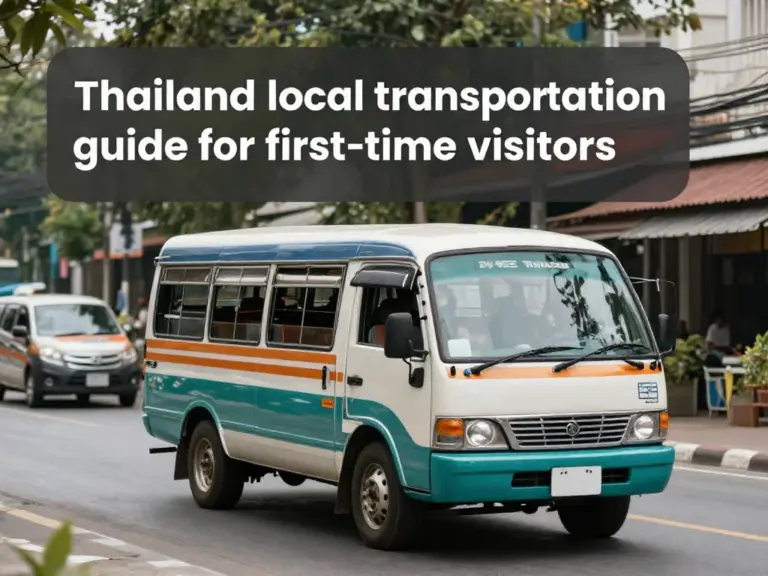
Tuk-tuks are an iconic part of the Thai experience, but they are generally more expensive than taxis for the same distance. They are best reserved for short, “fun” trips rather than commuting. Finally, in smaller cities or suburban areas, you might encounter ‘Songthaews’—converted pickup trucks with benches in the back. These operate on fixed routes like buses and are incredibly affordable, though they require a bit of local knowledge to know where they stop.
Comparison of Transportation Modes
| Mode | Convenience | Cost | Best For |
|---|---|---|---|
| BTS/MRT | High (Avoids traffic) | Low | Commuting within Bangkok |
| Grab/Bolt | High (Door-to-door) | Medium | Late nights, heavy luggage |
| Taxis | Medium | Medium | Short to medium distances |
| Tuk-Tuk | Low (Open air) | High (Tourist price) | Short, sightseeing joyrides |
| Songthaews | Low (Learning curve) | Very Low | Exploring local neighborhoods |
Practical Checklist for Your First Trip
To ensure your experience with local transportation in Thailand remains stress-free, keep this checklist handy:
- Download Grab and Bolt before you arrive.
- Keep small change (20, 50, and 100 Baht notes) for taxis and small vendors.
- Use Google Maps to verify the route your taxi driver is taking to avoid “scenic detours.”
- Dress modestly if you plan to use public transport in rural areas, as it is considered respectful.
- Avoid rush hours (7:00 AM – 9:00 AM and 5:00 PM – 7:00 PM) if you are traveling by road.
Conclusion
Mastering local transportation in Thailand is a rite of passage for any visitor. By leveraging mobile technology, understanding the distinct roles of the BTS and MRT, and maintaining a polite but firm stance regarding taxi meters, you can navigate the country like a pro. Remember that patience is the most important tool in your kit—traffic in Thailand is legendary, and sometimes the best travel plan is to simply enjoy the journey.
Frequently Asked Questions (FAQ)
A: Yes, apps like Grab and Bolt are generally very safe. They provide GPS tracking, driver identification, and a record of your trip, which offers more security than hailing a random taxi on the street.
A: Tipping is not mandatory, but it is common practice to round up the fare to the nearest 10 or 20 Baht as a gesture of appreciation for good service.
A: Unfortunately, no. The BTS uses the Rabbit Card, while the MRT uses its own separate EMV or stored-value card. You will need separate cards for each system.
A: Always agree on the price before you step into the tuk-tuk. If the price feels too high, walk away. It is often better to use a taxi with a meter for a more predictable and cheaper ride.